Showing posts with label Wisconsin State Journal. Show all posts

Tuesday, November 11, 2008

A study in editorial contrasts - bus edition

The Wisconsin State Journal and the Capital Times have long been held to be opposing voices when it comes to their editorials. The WSJ tends to hang a little to the right, and the Cap Times tends to hang a little to the left. And when the issues aren't necessarily of the partisan kind, they still do a good job of staying as far away from the others' opinion as possible.

Case-in-point: In the debate over whether or not to raise bus fares in the city of Madison to $2, the WSJ argues that yes, absolutely they should go up. The Cap Times, of course, argues the opposite. The language used in both editorials could not be more different. Whereas the WSJ uses words like "reasonable" and "modest" to describe the proposed rate hike, the Cap Times turns to descriptions like "dramatically" and "massive".

Personally, I think both editorials have a few worthwhile points. I also think they both fall flat in other areas.

In addressing a proposed amendment that would add a slight increase to property taxes to help avoid a rate hike, the WSJ complains that "It's time for those who actually ride the buses to contribute a bit more to maintain routes and improve service." While I certainly understand the concern of property taxpayers, I've got two issues with this. 1) Property taxpayers do ride the bus, too (shock! I know!). I know a few personally. 2) I don't think shifting the burden entirely onto the shoulders of frequent bus riders is the right thing to do. It is, in fact, quite insensitive to the facts about a lot of regular riders.

While it's true that a wide range of people from all different income brackets and walks of life use the bus, those who most rely on the service tend to be working class, or handicapped, or students (or any combination thereof). As a society, it behooves us to care for those most at risk. This must be balanced with personal accountability and responsibility on the part of those being helped, absolutely, but we cannot place the full financial burden of something as essential as the bus system on them and not expect it and them to crumble under the weight.

We should be encouraging more people to use mass transit, not vice versa. That means keeping it affordable, and finding other ways to fund it. Alders Brian Solomon and Satya Rhodes-Conway have proposed an amendment to the Mayor's budget that would do a lot (not all) to address this issue.

It would "delete the fare increase and save money in other ways. For example, Metro could bring in $40,000 in extra revenue by eliminating free rides on Clean Air Action days" (not sure how I feel about that, but if it helps keep fares low, it's worth considering). They also propose reallocating $100,000 in fuel savings, as apparently fuel costs were not as great as anticipated this year. The amendment also calls for an expansion of service, better marketing, and the implementation of new security programs at transfer points (which apparently involves a $25,000 cut, so that warrants further scrutiny).

While these measures may not be the end-all-be-all of the problem, they are a good example of the kind of creative and innovative efforts to reorganize so that the burden is not on the riders themselves.

Back over at the Cap Times editorial, while I generally agree with their ultimate point, their doom and gloom language does feel a little over the top. While I, and others, strongly suspect that a rate increase would have adverse effects on riders and ridership, until actual studies on the subject are done, no concrete conclusions can really be reached. Still, rather alarmist-ly, they ask:
Did right-wing critics of mass transportation take charge, in coalition with global warming deniers? Are the fantasists who would have us believe that our bus system is underutilized and unnecessary pulling a silent coup? Has a once progressive city suddenly forgotten that mass transit decisions go to the very heart of questions about equity and access for all to employment, education and culture?
I really don't get the impression that this all stems from some vast right-wing conspiracy. Rather, it strikes me as an honest debate over how to best address the severe budget shortfalls the city is facing. While there are some on the pro-hike side of the argument who seem to think that bus riders are all lazy liberal professors, the majority, I believe, are really trying to do the right thing. It's a complex issue, and one without an easy answer.

Ultimately, I do believe that it's in the best interests of the city to make sure public transportation is as affordable and convenient as possible. People rely on it to get to work, school, and other commitments. An employed, educated citizenry benefits everyone.

Monday, October 13, 2008

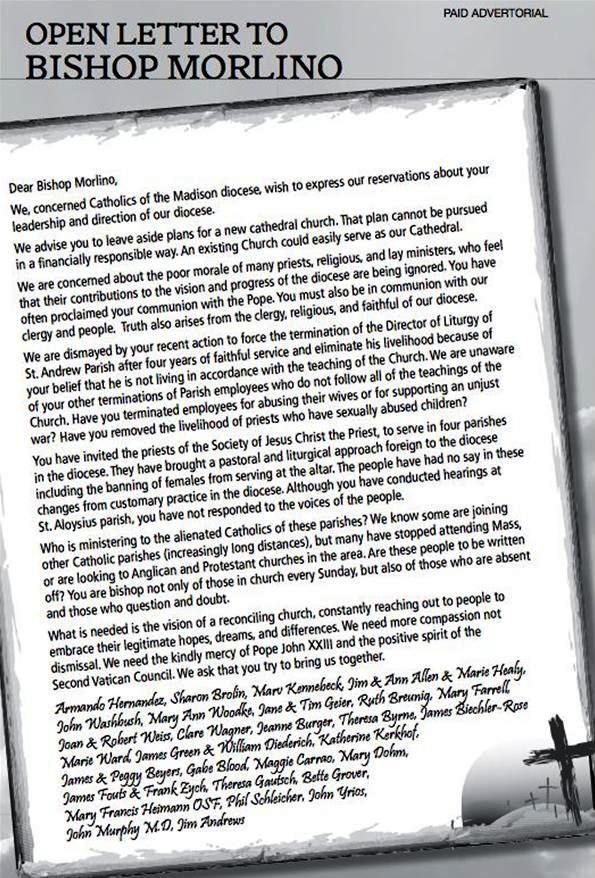
Kudos to area Catholics for standing up to Morlino

This weekend I picked up a copy of the Wisconsin State Journal and read, with an increasingly large smile on my face, an ad placed by the local chapter of Call to Action containing an open letter to Bishop Robert Morlino. In the letter, which they also delivered to Morlino himself, the group expresses their concerns over several things: Morlino's insistence on building a brand new cathedral, his leadership style's effect on the morale of priests, his single-minded focus on issues like abortion and homosexuality, the exclusion of women from the clergy, and the firing of an openly gay music director.

First off, I want to extend my support to those who backed the ad/letter, and hope that this movement meets with some success in helping to open a productive dialogue within the Church.

The WSJ also included an article about the letter and responses to it:
In a statement, the diocese said Morlino is sorry that "certain groups, who claim to be Catholic, would assume postures which clearly are not in accord with the teachings of the church."
This is what really gets up my guff: Morlino certainly has every right to disagree with the letter and its claims, but where he gets off shutting the whole thing down by immediately calling into question the letter writer's very Catholicism I don't even know. I would be pretty pissed, too, if the head of my church (or any organization to which I belonged) dismissed by valid concerns so easily. But that's just how Morlino rolls, it seems, as he bats off any and all criticisms with personal attacks.

No wonder some of the priests feel threatened enough to have formed their own support group, as detailed in the article:
Asked for evidence of poor morale among priests, several of the letter signers mentioned the Association of Madison Priests. The group was formed by priests to support each other and to provide a unified voice on issues in which they differ with Morlino, according to people familiar with the group.

"They feel the need to protect each other," said Joan Weiss of Prairie du Sac, a CTA leader. "They're concerned about retaliation if they speak out in opposition in any way."
Apparently, this sort of independent priest group is fairly rare, yet another sign that the situation with Morlino and his leadership style might just be a bit extreme.

I can't say I've been particularly surprised by Morlino's various outrages ever since learning that he is the chairman of the Board of Visitors at the Western Hemisphere Institute for Security Cooperation, formerly the School of Americas. Why is this fact so heinous? Well, WHISC/SOA is responsible for training some of South America's most notorious military criminals, some of whom were responsible for the murder of Jesuit priests. But Morlino defended his position with the institute and ignored the opposition of clergy in Madison.

I'm not Catholic, so I have been and will no doubt continue to be criticized for sticking my nose in where some don't think it belongs. I have several close friends who are Catholic, however, and I attended a Catholic college - so you'll excuse me if I have some interest in and empathy for those struggling with their own beliefs and those so vigorously being imposed on them from on high.

What's interesting, too, is that so many people who agree with Morlino and the positions he pushes, when confronted with fellow Catholics who disagree, often call into question those people's reasons for remaining Catholics. It's the "love it or leave it" frame of mind. A good example of this can be found at the blog of a one "Fr. Z", where he addresses the current hubbub over the letter. He refers to the independent priest's group as "cowards," and outright dismisses the dissenters as being 100% "wrong."

Heck, maybe it is time for the more modern, forward-thinking Catholics to start their own branch of the Church. It'd be a shame, because I'd much rather see the whole Church work together to move, in their own way, into the 21st century. But if the modernizers did form their own group, I suspect it would take a rather large chunk out of regular Catholic membership--maybe that would teach people like Morlino and the Pope a valuable lesson, ie: if you actually listen to the concerns of your parishioners instead of being so damn rigidly hierarchical and dismissing them outright, maybe you wouldn't be facing things like the current priest shortage or declining mass attendance.

The cynical side of me says let them eat cake and suffer the consequences of their stubbornly backward-looking policies - but like I said, I have many close friends who are Catholics, and they find a lot to love in the Church, things like its commitment to social justice, and even the more traditional services. So the idealistic side of me wishes for better and more open dialogue about the future of the church, allowing real input from everyone from lay people to priests to bishops, leading to some progressive changes in how things are done. Why not allow women into the clergy? Why not a greater focus on addressing poverty, hunger, and social justice, instead of such single-minded railing against things like homosexuality and abortion? Why not, in a world where the population is ever-exploding, relax the restrictions on contraception?

Whether that means outright removal of Morlino as bishop or just convincing the guy to be a little more open to input, I don't know. That's up to the Catholics. But this public criticism, and the group supporting it, are certainly a step in the right direction and I wish them luck.

Wednesday, July 23, 2008

Dey took er jerbs!

Through a series of Wikipedia-like random link clicks, I managed to land over at Widgerson Library & Pub, where I read a post by Deb Jordahl addressing Madison's recent fall from Money Magazine's "Top Places to Live" good graces.

We're still in the top 100, which is good, but we've fallen from our #1 slot in 1996 to #53 two years ago, and now, all the way to #89. Certainly, there are some interesting statistics cited by the magazine that point to problems in the city: lower math and reading tests scores than the national average, higher property taxes, and an increase in personal and property crime. These are all troubling statistics, and things of which I think/hope most Madisonians are aware.

As pointed out in the Wisconsin State Journal's op-ed about the ranking, though, it's important to be willing to take a hard look at our city and its various problems. It's also important, as they go on to note, not to place too much stock in the ever-changing qualifications for the rankings in the magazine. Madison may have dropped from its lofty heights on the list, but it's still in the top 100 out of tens of thousands of cities in the country.

Over at the Library & Pub, however, a much more dire picture is being painted, one where Madison is slipping into a dark abyss. The blame for this perceived state of affairs is placed squarely on the shoulders of "liberal policies" and "illegal immigrants," which is nothing particularly new. What's interesting is that this line of reasoning remains so persistent, even though 1) Madison still made the top 100, 2) the causes of slips in testing scores, employment opportunities, crime levels, and property taxes are many, varied and complex, and 3) there are pretty much no solid statistics or studies to back up their claims.

Do some immigrants sometimes commit crimes? Yes. Do some citizens also sometimes commit crimes? Yes. Will blanket anti-immigrant policies solve the crime problem? No, and they would likely just create a climate of fear and xenophobic nationalism, which is about as un-American as you can get.

The fact is that Madison has grown substantially in population and area over the last ten years, and coupled with the current national economic downturn, that's logically going to bring growing pains. We can't afford to ignore the problems, but we also can't afford to give knee-jerk responses to them. Pointing accusatory fingers at immigrants or liberals (or conservatives) isn't going to solve much of anything. We need to work together, and especially with those communities and populations most effected by the changes, to come up with comprehensive strategies that address not only the symptoms, but, more importantly, the root causes of the problems.

A larger gap between the wealthy and the working and middle classes, higher food and fuel costs, larger populations straining educational systems, less funding for school and community programs, and even pollution can all contribute to the things listed in the rankings. We need creative, compassionate, intelligent, and no-nonsense approaches to dealing with these various factors--not name calling, entitlement, resentment, selfishness or feelings of superiority.

Monday, June 30, 2008

The fight for James Madison Park

Thanks to Fearful Symmetries for pointing out this interesting little fight:
What happened to Jay Rath's rant that he posted this weekend up at POST? In it he was critical of this editorial by the WSJ regarding the use of land around James Madison Park. By "critical" I mean he basically told the WSJ editorial folks to go fuck themselves and to let downtown residents determine their own fate.
I went ahead and dug up the cached version of Rath's post to Post, which you can read in its entirety here. Basically, he strongly chastises the editorial for misrepresenting facts (for instance, that "the public can't access" certain parts of the park, which they can, in fact, do) and for basically arguing on behalf of the one lone voice that wants this sale to go ahead:

So far as I can tell, there's only one voice arguing for the sale of the property and nearby homes: the developer, Urban Land Interests. This is the same company that demands that the last portion of historic buildings on the Capitol Square be demolished (The Old Fashioned, L'Etoile and such), so it can put in a nearly block-sized development. This is the same developer that wants to demolish the oldest commercial building on the Square, the American Exchange Bank. This is the same developer that agreed to sell the Bartell Theatre property to the Bartell trust and Overture, and then reneged (because it wanted to demolish and put in a massive development), until forced by courts to comply with its own earlier written agreements; I reported all that, for Isthmus.

Yeah, I trust Urban Land. About as far as I can throw them.

Ald. Brenda Konkel has also weighed in on this bit of controversy.

It's strange that Rath's post on the subject appears to have since been removed from the website. I'm not sure if we should read some greater conspiracy into it, or if Rath himself decided to take it down for one reason or another.

Beyond that, however, those arguing against the WSJ article are all making good points. I, too, can't help but wonder why on Earth anyone would think the construction of yet more new condo developments would be good for Madison? Several current projects are already stalled due to the ever-tanking housing market, and that coupled with the general economic downturn doesn't exactly scream "Build more condos!" to me.

Why are we so intent on moving and/or demolishing the few historic structures we have in this town and this (relatively young) country anyway? And furthermore, why must every last scrap of undeveloped land go under the knife of "progress"? There's a major societal benefit in having more green spaces, parks, and just plain empty land. So how about instead of tearing stuff down and putting in yet more condos, we revitalize the existing downtown houses? There has been a plan floated in the city to create a fund to encourage families, etc., to buy older homes in the downtown area, so that if the current trend of students moving into newer housing and out of the old apartments continue, we won't be left with a slum. That's the kind of thing we should be encouraging. Leave the park alone.

Tuesday, April 1, 2008

Immigrant Punk

An interesting and somewhat troubling immigration case has recently bubbled to the surface here in Madison. Tope Awe, a Nigerian-born graduate student at the School of Pharmacy at the UW-Madison, was unexpectedly taken into custody by the Milwaukee office of Immigration and Customs Enforcement last week, and is now being held in the Dodge County Jail awaiting deportation.

According to the Capital Times:

Friends said she had gone to discuss her immigration status. Awe reportedly came to the United States with her family at age 3, and friends said she knows no one in Nigeria.

ICE spokeswoman Gail Montenegro said Monday that Awe was an immigration fugitive with an outstanding removal order against her. Immigration fugitives typically do not have the right to a hearing before deportation, Montenegro said.

The 22-year-old student's father, Samuel Awe, lost an appeal for political asylum in 2003. That decision in the 7th U.S. Circuit Court of Appeals found that Samuel Awe's removal from his 1993-1995 stint as Nigeria's agriculture secretary, reportedly for not paying bribes to supervisors, and accusations that the frequent resident of the United States had ties to the CIA did not rise to the level of persecution.

Samuel Awe, his wife and three children were originally notified in 1998 that they had overstayed their visas, according to court documents. In denying Awe's appeal, the court granted the family voluntary departure to Nigeria.

Tope Awe was in custody Monday at the Dodge County Jail, which contracts with ICE. Also in custody was her brother, Oluwagbenga Awe, also seized on Thursday. He is a recent graduate of UW-Stevens Point and, according to family and friends, is married with a young child.

Samuel Awe and his wife, Julianah, live in the Milwaukee area where he is receiving medical treatment, according to published reports.
It's difficult to get a firm handle on the situation, as the details of the Awe's visa status are still murky. The family claims that the father's B-1/B-2 visa, for business and medical purposes, allows them to stay here until his treatment is finished. It is unclear, however, if 1) the visa applies to just Sam or to the whole family and 2) the visa is good until the completion of treatment. Sam Awe has kidney disease and has been undergoing treatment for it in Milwaukee for a number of years. I can't imagine he'd be able to get the same level of care if sent back to Nigeria.

Perhaps more confusing is Tope's student status. Having lived in Wisconsin for several years prior to enrolling both as an undergraduate at UW-Milwaukee and as a graduate student at UW-Madison, state residency was apparently not a problem to prove. But if the Awe's were notified in '98 that they were supposed to leave the country, how did they manage to stay on (and, for the children, attend state schools) for another 10 years? How did this never come up during enrollment?

Personally, I believe that anyone who has proven a commitment to being a contributing and law-abiding member of society should be granted permanent resident status. The Awe's seem to have done just that, but were instead rewarded with a denial of either an extension to their stay or a path to citizenship. Tope appears to have been an exemplary student, highly involved in campus life and advocacy while pursuing her studies. That she was asked to come in for a meeting to "regularize her residency status," voluntarily complied, and then simply arrested seems sketchy at best.

Still, all of the facts remain to be seen, and for better or for worse, the law is the law. So the trouble may be less that the law was enforced, and more that the law is broken.

This family clearly wanted to stay in the United States, and were, from what I've read, doing everything they could to do so legally. They paid taxes, registered cars, contributed to their communities, and plead their case all the way up to the U.S. Circuit Court of Appeals--only to meet with a door slammed in their faces. I can't blame them for fighting tooth and nail to stay here. Unfortunately, with the way the laws work now, they may have little to no recourse in this situation.

It is heartening to know that a significant number of Tope's fellow students and teachers are going to bat for her, pushing for her to be allowed to stay in the country at least until she graduates in 2009. An online petition has already garnered hundreds of responses, a number of UW officials are advocating for her, and state representatives have at least been contacted about the case.

This all just serves as yet another reminder of how complicated and dysfunctional our current immigration laws are. We really do need to find a way to get past all of the jingoism and knee-jerk reactions to the subject, and find a way to meaningfully debate and rework our policies. Policies that should have nothing to do with xenophobia and "dey took er jerbs!" style fear. We are, after all, a nation founded by immigrants (I'm talking about the nation founded long after the first inhabitants arrived here--which is a whole other story, of course). Ignoring that heritage, willfully or not, is hypocritical at best, dangerous at worst.

Monday, March 3, 2008

The air up there

The governor of our fine state, Jim Doyle, is pulling some interesting tricks in regards to air quality standards. He sent a letter to the EPA asking them to declare all Wisconsin counties to be in compliance with federal clean air standards, despite the fact that several counties were found to be in violation of those laws.

We wouldn't have known about this bit of chicanery, however, were it not for the open records request put in by the Sierra Club. It was this same sort of request that forced the issue on the Charter Street coal power plant here in Madison. The lesson I'm taking away from all of this? Contrary to the claims of some laissez-faire adherents, it often takes government regulation to force industries and businesses into cleaning up their act, and that it takes a great deal of oversight by the public-at-large to keep the government in line.

I can see why folks might be put off by the process. It's a lot of work, but it's important for all of us to put in the time and the effort.

Doyle's latest maneuvers are especially irksome considering, among other things, the many air quality alerts issued so far this winter.
Dane County has been hit with numerous air quality alerts for particle pollution by the state Department of Natural Resources this winter. And the American Lung Association last year gave the county a "D " on its annual air quality report because of the increasing levels of particle pollution. Numbers from the association show the county is home to 33,264 adults with asthma, 8,731 youths with pediatric asthma, and 14,323 people with chronic bronchitis.
I don't know about you, but I'm not super psyched about all of that. Doyle's excuse is that federal guidelines create too much red tape and would take longer than laws either currently or soon-to-be on the books in the state. On the one hand, I absolutely applaud the efforts by the administration to implement stricter pollution controls (like reducing mercury emissions, etc.), but the level of secrecy involved in Doyle's letter and a conflicting recommendation from DNR staff certainly raises suspicions over whether or not they're working on behalf of the public good or for industry interests.

It's important to help foster development and growth for businesses in the state, but bypassing important and necessary environmental regulations to do so is downright shameful. All of the foot dragging and back room deal-making in the world won't amount to a hill of beans if no one can breathe the air outside without risking major health problems.

(h/t The Political Environment)

Friday, February 15, 2008

A farewell to paper and ink

Last Thursday, Madison-based newspaper the Capital Times announced that, after 90 years as an afternoon daily, it would be switching to a predominantly online presence, with a twice weekly tabloid sized paper going out with its sister publication, the Wisconsin State Journal.

Everyone and their uncle has since commented on the change, and I've been reluctant to add my voice to the cacophony both because I was never a subscriber to the paper and because the issue of news moving away from print and toward the internet is anything but black and white.

I have a few reasons, some superficial, for preferring to get my news online. I enjoy the wide variety of sources and perspectives that are so easily available via the internet. Also, though, in the past few years I've developed a mild allergy to newsprint that makes reading the paper a less-than pleasant process. I blame all the time I spent working as co-editor of my college paper and the huge quantities of ink I likely inhaled during that time, but whatever the real cause, it's hard to read when you're so busy sneezing.

Still, there's something fundamentally necessary about the local newspaper. In some cases, they're a community's only source for local news. And yes, even in this day and age, there are still many people who don't have or can't afford regular internet access. In their case, the local newspaper may be their only source of written news.

In their heyday, there were around 1,500 afternoon/evening papers in print. That number has since fallen dramatically, to just around 700. The average number of households that subscribe to one or more papers has also fallen, with readership numbers failing to keep pace with the growth in population (source).

Internet news is great for its sheer scope and variety, but when a publication switches from predominantly print to predominantly electronic, the move is typically coupled with a dramatic cut in staffing. That's the main worry I have when it comes to the Capital Times' changes.

First off, the support staff loses their jobs: the people who work and maintain the printing presses and those who deliver the papers. Lower level copy editors, often individuals trying to break into regular reporting, are likely to be cut as well. Even some seasoned vets will lose their jobs. All told, the cuts in staff lead to fewer eyes and ears on the ground, less thorough coverage of the various newsworthy events around town, and thus, less variety.

I can't be alone in the fact that I read local and regional news sources for local and regional news, and not so much for national or international items. It's the same reason why I try to keep my pontificating on this here blog away from too much national or international issues and stick with more local stories. There are plenty of better qualified people covering the world (and with the internet, we have far greater access to those sources, many of which are more local to the events). People turn to local news sources, and yes even bloggers, for local content, stuff that likely won't be covered anywhere else.

All this isn't to say that I suspect The Capital Times will stray away from covering local and regional content. But their ability to cover as much of it will certainly be hampered by the cuts in staffing that become necessary when your sole source of revenue are online ads. And that, I think, is what concerns me the most.

In the end, I will reserve judgment until their new incarnation has had time to prove itself one way or another. I sincerely hope that they're able to maintain high quality and diverse coverage. And I thank everyone at The Capital Times for 90 years of progressive news delivery.

Sunday, January 27, 2008

The Massacre begins tonight!

If you haven't already seen the buckets of press about it, "Massacre (The Musical)" has its world premiere tonight, 8:00PM at the High Noon Saloon. I'm shamelessly plugging the heck out of this because 1) it's a super fun, super indie horror musical comedy, 2) I helped create the soundtrack and did some grip work on it and 3) my band, Aporia, is playing after the screening. And hey, the whole evening will only cost you $5, a portion of which will go to benefit Second Harvest. Good times, all around.

Read all about it!

Today's issue of the Wisconsin State Journal features a big article about it on the cover of their Art section. You can read it online here.

This weeks' issue of the Onion's AV Club (in Madison) features an article about it, too.

This weeks' issue of the Isthmus also includes a nice article about the premiere. I wrote an article for their online edition, if you care to read it, here.

Wednesday, December 5, 2007

Freedom to be an idiot

I'm a little behind the times (so what's new) because I only just read about this today (h/t CP):

James Buss, 46, was arrested last week for the Nov. 16 post he made on www.bootsandsabers.com, a popular conservative blog that covers Wisconsin politics.

Buss wrote their salaries made him sick because teachers are lazy and work only five hours a day. He praised Eric Harris and Dylan Klebold, who killed 12 students and a teacher before committing suicide in the April 1999 attack at Columbine High School.
It's an idiotic, trolling comment to make--I don't think anyone with half a brain would argue with that. But arresting the guy and then continuing to hold him even after finding nothing incriminating in his house or his past? That's just as ridiculous. The boys at B&S put it pretty well, actually:

I realize that in a post-Columbine world that everyone is hypersensitive about any mention of Columbine or school shootings. But this comment was clearly just talk. When I gave the detective the IP address, I assumed that they would find him, chew him out a bit for being an idiot, and leave it alone. The fact that the West Bend Police decided to actually arrest him in the absence of any additional evidence of this guy being a threat is out of line.

I encourage the District Attorney’s office to promptly no bill this matter. Yes, we need to be concerned with statements like this and it was appropriate for the police to look into it. But once they found out that he was no threat and once the comment had been removed, thus eliminating the likelihood that the comment would encourage anyone else to commit violence, they should have dropped it.

Indeed. Otherwise, where do we draw the line? Or will there even be a line at all?

Tuesday, November 27, 2007

The good, the bad, the ugly deniers

I'm reading about Fort Atkinson's very cool Heart of the City program, a voluntary "diet" that has citizens cutting their energy usage and greenhouse gas emissions. It sounds like a great idea, and seems to have led to some serious savings, both in terms of energy and money, for the town.

But then, upon reaching the bottom of the article, I come across that chronic buzzkiller, the Global Warming Denier. It seems as though the WSJ Forums have picked up one of their own, as this forumite has been popping up in the comments section of many articles that, in one way or another, touch on the issue of global warming.

I understand that there is still debate in the scientific community over the severity and exact causation of the problem. The great thing about modern science, though, is that through use of the scientific method, we're able to sift and winnow our way closer to more and more truth every day. Still, there are those who would prefer to stick their heads in the sands (y'know, the sand that used to be fertile ground but that was ruined by human overuse and such?). They deny the very thought that humanity's actions may be interfering with the delicate balance of the Earth.

How they continue to live in such an anti-reality zone is beyond me, especially considering the wealth of research from all corners of the scientific spectrum to support the theory that yes, we are in fact changing our world, and not so much for the better.

Have some facts:

Average temperatures have climbed 1.4 degrees Fahrenheit (0.8 degree Celsius) around the world since 1880, much of this in recent decades, according to NASA's Goddard Institute for Space Studies.

• The rate of warming is increasing. The 20th century's last two decades were the hottest in 400 years and possibly the warmest for several millennia, according to a number of climate studies. And the United Nations' Intergovernmental Panel on Climate Change (IPCC) reports that 11 of the past 12 years are among the dozen warmest since 1850.

• The Arctic is feeling the effects the most. Average temperatures in Alaska, western Canada, and eastern Russia have risen at twice the global average, according to the multinational Arctic Climate Impact Assessment report compiled between 2000 and 2004.

• Arctic ice is rapidly disappearing, and the region may have its first completely ice-free summer by 2040 or earlier. Polar bears and indigenous cultures are already suffering from the sea-ice loss.

• Glaciers and mountain snows are rapidly melting—for example, Montana's Glacier National Park now has only 27 glaciers, versus 150 in 1910. In the Northern Hemisphere, thaws also come a week earlier in spring and freezes begin a week later.

• Coral reefs, which are highly sensitive to small changes in water temperature, suffered the worst bleaching—or die-off in response to stress—ever recorded in 1998, with some areas seeing bleach rates of 70 percent. Experts expect these sorts of events to increase in frequency and intensity in the next 50 years as sea temperatures rise.

• An upsurge in the amount of extreme weather events, such as wildfires, heat waves, and strong tropical storms, is also attributed in part to climate change by some experts.

• Industrialization, deforestation, and pollution have greatly increased atmospheric concentrations of water vapor, carbon dioxide, methane, and nitrous oxide, all greenhouse gases that help trap heat near Earth's surface. (See an interactive feature on how global warming works.)

• Humans are pouring carbon dioxide into the atmosphere much faster than plants and oceans can absorb it.

• These gases persist in the atmosphere for years, meaning that even if such emissions were eliminated today, it would not immediately stop global warming.

• Some experts point out that natural cycles in Earth's orbit can alter the planet's exposure to sunlight, which may explain the current trend. Earth has indeed experienced warming and cooling cycles roughly every hundred thousand years due to these orbital shifts, but such changes have occurred over the span of several centuries. Today's changes have taken place over the past hundred years or less.

Please refer to the IPCC's 2007 Report on climate change for more in-depth details and research.

You can deny until you're blue in the face, but it ain't gonna make the problem go away.

And hey, curious to calculate your household's emissions and waste? There's a very decent personal calculator available over at the Environmental Protection Agency. Looks like my house came in under the national average, which makes me feel good, but then I have to think about the bigger picture and the fact that, if everyone on Earth lived like I do, we'd run out of resources pretty much immediately. Yikes. Still, every little bit counts, especially if those little bits end up leading to bigger things.

More progress on power plant clean up

A reassuring article in the WSJ today, detailing the further ramifications of the Sierra Club's successful lawsuit against the UW's Charter Street coal fired power plant:

The state of Wisconsin has agreed not only to clean up UW-Madison's coal-fired Charter Street power plant but also to review and possibly improve the operation of 13 other coal-burning plants it manages throughout the state, according to a settlement of a Sierra Club lawsuit announced Monday.

...

That decision led to Monday's broad settlement, which averted a federal court trial on remedies that was set to start Monday. The state agreed not only to immediately reduce coal use by 15 percent at the Charter Street plant but also to review its operation and if needed, clean up emissions at 13 coal-burning plants elsewhere, including Capitol Heat and Power on Madison's Isthmus.
I can tell you right now that it is needed, but I'm glad to see that the state is starting to take this seriously. It's a real shame that it look a serious lawsuit for them to start cleaning up their act, but better late than never, I suppose.

With all the lip service the Doyle administration has been paying to cleaner air and lower emissions, it's going to take some serious effort to make the action match the rhetoric. This looks to be a huge step in the right direction.

Of course, one need only to look to the bottom of the article at the first comment, where some poor soul posts the following deluded message: "Thank you, Sierra Club. Once again we get MUCH HIGHER energy prices in the name of the Great Global Warming Hoax," to be reminded that we've a long way to go when it comes to educating the public about the issues.

I'm torn between laughing and crying, really, there's so much that's wrong with that statement. The Great Global Warming Hoax? That thing that the vast majority of the world's qualified scientists agree is happening? Yeah, aside from that, we're talking about simply making the air we breathe far less toxic, something that tends to benefit poorer communities first, as they're usually the ones with the big ol' smoke belching power plants built at their centers.

Alternative fuels are proving to be viable and affordable sources of energy. With the appropriate amount of willpower and funding, they will only continue to increase in efficiency and affordability. A head-in-the-sand attitude like the poster's is what got us into this mess in the first place, and it's what will help lead us to disaster if it continues.

Anyway, I intend to keep a close eye on how this power plant clean-up progresses, and hopefully more influential people than I will do the same, so we make sure they get it right this time, instead of slacking off and waiting for next year like they've done so many times before.

Wednesday, November 7, 2007

The State Journal hearts military recruitment

Surprise, surprise: The Wisconsin State Journal thinks the school board should ignore protesters and allow military ads in gyms and stadiums.

They add this caveat: "Access should include the ability to buy ads in school sports stadiums and gymnasiums, as long as the ads comply with school district standards." But here's the thing, those ads don't comply with district standards, which state that all military recruiting materials must be placed in guidance offices. You can argue 'til you're blue in the face that the ads aren't "recruiting materials," but the fact remains that, by dint of offering a phone number to a recruiting office, they violate school policy.

I suppose I should have seen the opinion coming, but I can't help but be optimistic that people will more thoughtful and intelligent than that. It'll probably be my undoing.
The Lost Albatross